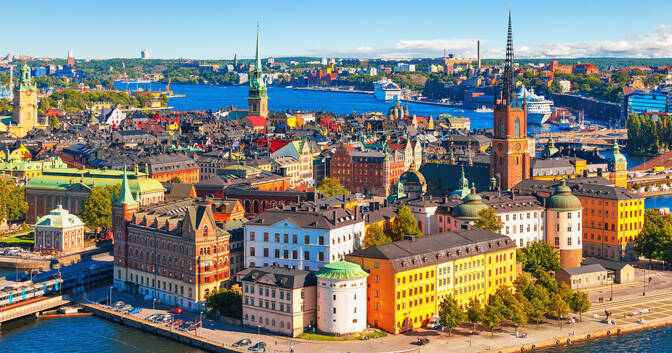
Scandinavia—often associated with social balance, sturdy welfare units, and cultural cohesion—has been through substantial demographic and cultural shifts over the past handful of a long time. Immigration has launched new languages, religions, and social dynamics, prompting ongoing debates about integration, identification, and the way forward for the Nordic design.
From Homogeneity to Variety
For Substantially of your twentieth century, Scandinavian societies were being characterised by a large degree of cultural, linguistic, and institutional homogeneity. International locations like Norway, Sweden, and Denmark shared reasonably uniform populations, formed by widespread histories, sturdy nationwide identities, and carefully aligned social norms. This cohesion played a foundational part in the development from the Nordic welfare model, which relies on high amounts of belief, collective obligation, and wide community assist for redistribution.
This demographic balance began to shift in the postwar interval, in the beginning by labor migration. In the sixties and seventies, employees from Southern Europe, Turkey, and elements of Asia were recruited to aid rising industrial economies. While a lot of have been anticipated to return house, a significant selection settled completely, bringing households and establishing communities.
With the late twentieth century onward, the speed and nature of immigration changed. Refugee actions from conflict regions—such as the Balkans, the center East, and elements of Africa—released new Proportions of diversity. Concurrently, globalization and European integration enhanced mobility inside and further than the area, additional diversifying populations.
City centers turned the focal factors of this transformation. Metropolitan areas like Oslo, Stockholm, and Copenhagen developed into multicultural environments wherever several languages, religions, and cultural tactics coexist. Neighborhoods which were once somewhat uniform now reflect a variety of backgrounds, reshaping every day interactions in faculties, workplaces, and general public spaces.
This changeover has had both equally structural and symbolic implications. On a structural stage, institutions created for relatively homogeneous populations have needed to adapt to new social realities. Education programs, labor marketplaces, and public products and services progressively handle linguistic diversity, assorted cultural expectations, and differing socioeconomic commencing details.
Symbolically, the shift issues long-standing narratives of nationwide id. The idea of a shared cultural baseline is not self-apparent, prompting ongoing conversations about belonging, integration, as well as the definition of “nationwide” society.
The move from homogeneity to variety hasn't been linear or uniformly experienced. Outcomes change across regions, communities, and generations. On the other hand, the general trajectory is clear: Scandinavian societies are not outlined by uniformity, but by an evolving combination of identities that continue to reshape their social and cultural landscapes.
The Integration Design Stressed
Scandinavian integration products have historically been created on universalism: equivalent usage of welfare, education, healthcare, and labor markets as the principal system for incorporating newcomers. The fundamental assumption is that powerful institutions, combined with substantial-high-quality general public services, will minimize inequality and permit immigrants to be economically and socially built-in after some time.
In observe, however, this model has faced growing strain. 1 central challenge is labor industry integration. Scandinavian economies are hugely regulated, with sturdy unions, significant wage flooring, and an emphasis on official qualifications. Even though these characteristics defend staff, Additionally they generate limitations to entry for newcomers who may possibly absence acknowledged credentials, nearby language proficiency, or Expert networks. Because of this, employment gaps between indigenous-born populations and immigrants persist in several parts.
Education and learning programs experience parallel pressures. Educational institutions are anticipated to integrate learners from numerous linguistic and cultural backgrounds when keeping substantial academic standards. In neighborhoods with concentrated immigrant populations, disparities in instructional results can emerge, reinforcing extended-term inequalities. These styles complicate the purpose of equal opportunity that underpins the welfare product.
Residential segregation adds A further layer of complexity. In big urban areas, sure districts became linked to greater concentrations of immigrant populations. Though these communities can offer social assistance and cultural continuity, they can also Restrict interaction with broader Modern society if economic and social mobility is constrained. This spatial dimension makes integration not simply a policy difficulty, but a geographic one particular.
In response, governments have modified their methods. Insurance policies progressively emphasize language acquisition, employment incentives, and civic participation. Some international locations have introduced stricter necessities for residency or citizenship, linking them to integration benchmarks. Other individuals have tightened immigration controls to deal with the size and rate of arrivals.
These shifts mirror a broader rigidity: keeping inclusive welfare systems when making certain their very long-phrase sustainability. The Nordic product depends upon common participation and believe in in establishments. When integration results drop shorter, political stress grows to recalibrate insurance policies.
The result can be a product in transition. The rules of universalism remain, However they are increasingly being reinterpreted in response to new demographic realities. Integration is not assumed to abide by immediately from use of services; it really is significantly treated being a structured, conditional system requiring Energetic participation from both equally individuals and institutions.
Identification and Community Discussion
Immigration has shifted questions of national identification in Scandinavia from implicit assumptions to specific general public discussion. Societies that once relied on the mostly shared cultural framework now facial area the task of defining belonging in more pluralistic phrases. This has manufactured id not merely a cultural issue, but a political and institutional 1.
Community discourse ever more facilities on values rather then ethnicity alone. Concepts like gender equality, secularism, independence of expression, and have faith in in community establishments in many cases are framed as Main features of Scandinavian id. The talk is less about whether or not diversity exists and more about how check here far it could extend with out altering these foundational norms. This reframing reflects an attempt to define id in civic rather than purely cultural conditions, nevertheless the boundary concerning The 2 is frequently contested.
Political responses range throughout nations. In Denmark, debates have tended to emphasize cultural cohesion and also the dangers of parallel societies, leading to extra restrictive integration and immigration policies. Sweden has Traditionally promoted multiculturalism and openness, while climbing worries about crime, segregation, and social fragmentation have shifted parts of The talk towards stricter actions. Norway frequently occupies a middle floor, combining reasonably open policies with gradual tightening and an emphasis on integration results.
Media coverage and public narratives Participate in a big position in shaping perception. High-profile incidents—irrespective of whether relevant to crime, social unrest, or integration challenges—can amplify fears and affect policy way. Simultaneously, achievement tales of integration, entrepreneurship, and cultural contribution obtain comparatively less notice, generating an imbalance in how immigration is perceived.
The debate also demonstrates generational and geographic distinctions. City regions, exactly where range is much more obvious and normalized, typically method id much more flexibly. Rural locations, with significantly less immediate exposure to immigration, may perhaps watch modifications extra cautiously. More youthful generations, escalating up in more numerous environments, often undertake broader definitions of belonging.
In the end, id in Scandinavia is no longer a set concept but an evolving negotiation. Immigration has manufactured visible the underlying values that determine these societies, forcing them to articulate what was as soon as taken with no consideration. The outcome stays open up, formed by ongoing dialogue among custom, plan, and lived expertise.
City Realities and Everyday Integration
Integration in Scandinavia is most tangible with the city level, in which insurance policies meet lifestyle. Metropolitan areas which include Oslo, Stockholm, and Copenhagen perform as Principal sites of interaction amongst newcomers and founded populations, making them central to how integration succeeds or fails in apply.
Work is a crucial determinant. Use of the labor sector not only offers cash flow and also facilitates language acquisition, social networking sites, and a way of belonging. Nonetheless, entry obstacles—for example credential recognition, language prerequisites, and limited Expert networks—can delay participation. When employment is unevenly distributed, it reinforces broader patterns of inequality which can be seen in distinct neighborhoods.
Education and learning performs an Similarly important job. Schools work as early integration environments where children from various backgrounds interact and adapt to shared norms. In nicely-resourced locations, This may foster cohesion and upward mobility. In more segregated districts, nevertheless, colleges might encounter concentrated difficulties, such as language gaps and varying amounts of prior instruction, that may have an impact on very long-expression outcomes.
Housing patterns further condition integration. In lots of Scandinavian metropolitan areas, immigrant populations are disproportionately concentrated in particular city districts. These parts typically give affordability and Neighborhood support but may Restrict exposure to broader Modern society if mobility is restricted. As time passes, such spatial focus can cause parallel social constructions, where conversation across teams will become considerably less frequent.
General public institutions—transport, Health care, Neighborhood facilities—serve as everyday Get hold of factors. Their accessibility and quality impact how folks navigate town and interact with broader society. Productive institutions can cut down friction and advertise inclusion; strained or uneven services can deepen divides.
Social conversation outside official methods is Similarly essential. Workplaces, general public spaces, and civic businesses produce alternatives for informal Get hold of, which can be important for creating belief. Without having these interactions, integration threats remaining administrative as opposed to social.
City realities highlight that integration is just not a single coverage consequence but a cumulative method formed by multiple variables. It depends on how folks Are living, function, examine, and shift within the metropolis. Results is consequently uneven and context-dependent, reflecting the complexity of translating nationwide insurance policies into daily practical experience.
An Id Nonetheless in Formation
Scandinavia’s evolving identification is not really moving toward a set endpoint but unfolding being an ongoing system formed by demographic alter, policy adaptation, and every day working experience. Immigration has introduced new cultural layers into societies as soon as outlined by relative uniformity, generating id fewer static and more negotiated.
1 crucial shift would be the motion from implicit to express definitions of belonging. Beforehand, shared norms and cultural references demanded little articulation. These days, these exact same factors are progressively debated, formalized, and often contested. Identification is currently being reframed with regard to values—which include equality, belief, and social obligation—rather then purely heritage or origin. Having said that, translating these summary rules into inclusive, realistic frameworks continues to be advanced.
Generational adjust plays a major part. More youthful populations, especially in urban spots, normally improve up in assorted environments the place a number of identities coexist. For them, hybridity is normalized as opposed to Excellent. This contrasts with older frameworks that emphasised cultural continuity and cohesion. After some time, these generational variances are prone to reshape how national id is recognized and expressed.
Institutionally, the problem lies in adapting methods crafted for homogeneity to additional varied populations without having weakening their Main features. Welfare versions, education units, and labor marketplaces should keep on being productive although accommodating varied linguistic, cultural, and socioeconomic backgrounds. This necessitates constant adjustment instead of a person-time reform.
There exists also an external dimension. Scandinavia’s world wide picture—as open up, egalitarian, and steady—interacts with interior debates about integration and identification. Policies and community discourse are influenced not simply by domestic issues and also by how these societies place them selves internationally.
Importantly, identification development just isn't entirely driven by plan. It really is formed by means of day by day interactions—how folks do the job collectively, share Areas, and negotiate variations in exercise. These micro-level dynamics slowly impact broader societal narratives.
The result is really an identity that is certainly neither absolutely cohesive nor fragmented, but in transition. It incorporates aspects of continuity together with emerging kinds of range. Rather than replacing just one product with Yet another, Scandinavia is layering new realities on to present buildings.
On this feeling, id is not getting missing but redefined. It has become much more intricate, additional express, and much more adaptive—reflecting the realities of societies which can be no more uniform, but nonetheless seek cohesion in modifying problems.
Closing Views
Scandinavia’s experience with immigration and integration reflects a broader transformation from stable homogeneity to managed diversity. The region’s power has extended rested on have faith in, solid establishments, and shared norms, but these foundations at the moment are remaining analyzed and reinterpreted. Integration is now not assumed to follow automatically from access to welfare methods; it demands active participation, policy adaptation, and sustained social interaction.
What emerges is not a breakdown of identity, but a far more elaborate Variation of it. Scandinavian societies are redefining belonging in ways in which harmony continuity with transform, custom with inclusion. Outcomes continue to be uneven, and debates usually reflect genuine tensions in between openness and cohesion.
However the process alone is critical. In lieu of remaining static, these societies are actively negotiating their foreseeable future form. Immigration has created identity more obvious, additional debated, and in the long run far more dynamic—turning it into one thing constantly formed rather then Traditionally mounted.
Comments on “Immigration and Integration: Scandinavia’s Evolving Identification By Guss Woltmann”